In this post, I’ll discuss why API testing is important, a typical situation that a tester might experience, and how to perform API testing with Web Performance Tester.
Web Performance Tester offers several tools for changing recorded hostnames. Below, I describe common situations users may experience, and the appropriate method of changing datasources for each.
If you’ve been following the quick pace of development of our real-browser features, we know you’ll be excited about these new features:
Extract values
Data in the browser can now be extracted into a user state variable for use later in the testcase. Read more…
Organize testcase steps
The steps in real-browser testcases can now be organized into hierarchical groups for better readability and easier maintenance. Read more…
Improved selection from choice boxes
Drop-down choices now support selection by position in the list (i.e. index) and by the option value (a hidden attribute in the HTML). Continue reading »
The first release of Web Performance Tester (WPT) with real browser support allow users to select items from a drop-down list (an HTML Select element) based on the text visible to a human user – just like a real user would do. There are times, however, when choosing based on the position in the list (index) or the hidden value of the selection makes a testcase more robust. This is especially true when the text descriptions of the choices may change due to variations in language, software changes, etc.
Starting with version 6.5, real-browser testcases can be configured to select by … Continue reading »
Occasionally, a testcase requires a bit of information from one page in the testcase to be used on another page, later in the testcase. In some cases, this is exactly what a real user would do (e.g. click on a link chosen based on text that appeared earlier). Other times, it is a hidden identifier that is used to choose the right element from a list later. Either way, an Extract a value step can be used to get data from the browser.
In the above example, an attribute value is extracted and stored in a user state variable named … Continue reading »
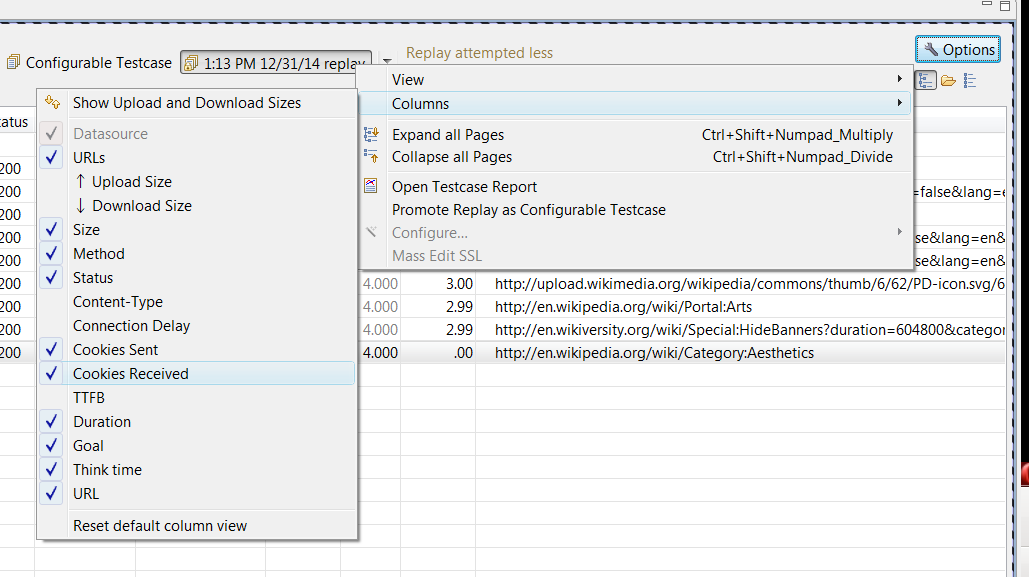
Load Tester 6.5 adds a quick and easy option for inspecting cookies in your testcase, and reviewing how they are used in a replay. Starting with Load Tester 6.5, the testcase editor adds two new columns: Cookies Sent (by the browser, to the server), and Cookies Received (by the browser, from the server). To enable these columns, simply select Options -> Columns.
The columns will display the number of cookies present in a transaction. In the case of a web page, it will identify the number of unique cookies sent or received. Simply hover over for a tool-tip, which will … Continue reading »
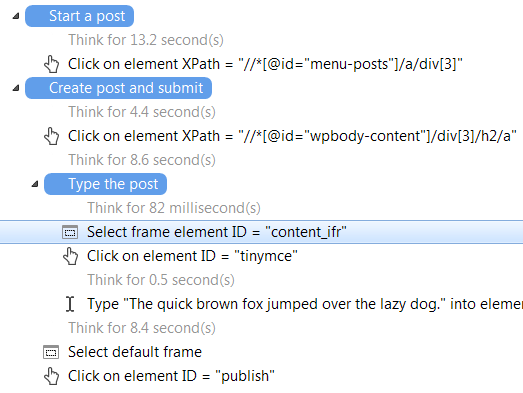
With Web Performance Tester 6.5 (WPT), you can easily organize the steps in your testcases into groups to make them easier to read and maintain. You can create groups within groups with no limit on the depth. This example shows three groups – the 3rd (Type the post) is contained in the 2nd (Create post and submit). The fourth group, not shown here, includes all the steps in the testcase (i.e. the entire testcase is a group).
Increased productivity and editing on-the-fly
Create groups just like any other step – add a step and change the type to Group. Quickly create your … Continue reading »
Dealing with file downloads is considered by many to be problematic when developing testcases with Selenium/WebDriver. Web Performance Tester (WPT) makes this task relatively effortless when working with Chrome – when the virtual user will initiates a download (by clicking something), the file will be downloaded into a directory that exists only for the duration of that testcase. This solves one problem – running out of disk space due to files downloaded during test iterations – because when the testcase ends, the temporary folder is removed along with the downloaded files.
Some tests require validating the content of the file, so … Continue reading »
Real-browser testing can increase your productivity over other testing methods. The features added in the 6.4 release will help you work even more efficiently!
Locator Suggestions
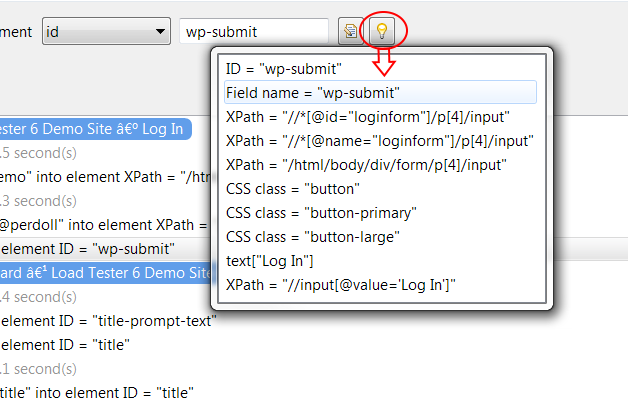
One of the more challenging aspects of working with real-browser testcases is locating the element that you need to interact with. Starting in 6.4, a suggestion button next to every locator field will provide a variety of different locators that you can try if the default locator does not work. These suggestions also help you learn how to create locators – as you will see a wide variety of locator suggestions provided.
Read more about Continue reading »
When building a testcase to simulate your users, at some point, you’ll want to ask how much variation you can add to your testcase. Real users may be doing searches, but there’s a good chance that your users are using different search terms. Likewise, users may be entering records, but most likely not every record should be entered identically. Every version of Load Tester & QA Tester support the use of datasets, to make it easy to create a list of terms, which can be supplied back as a virtual user traverses their workflow. However, for drop-downs or radio buttons, … Continue reading »