Recently Microsoft has been pushing their new Edge browser release by forcing users to start it upon login. If you want to start recording with Edge then Load Tester has you covered with just a few configuration steps.
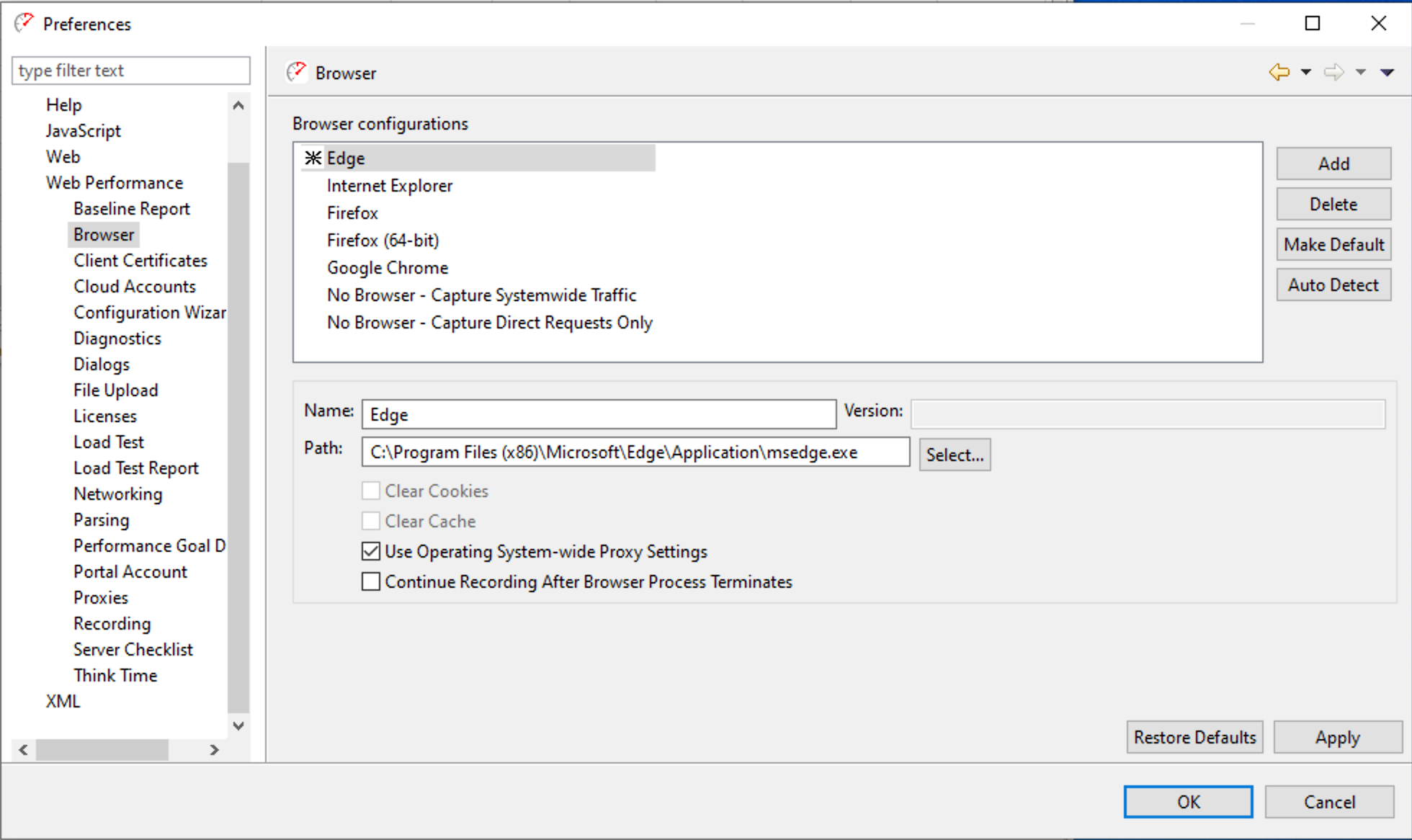
First, go to the Browser settings in Load Tester: Window->Preferences->Web Performance->Browser
Click the Add Button on the right and configure a new setting for Edge. The path is as shown above for Windows 10.
Be sure to check “Use Operating System-wide Proxy Settings”!
^^^^^^^^^^^^^^^^^^^^^^^^^^^^^^^^^^^^^^^^^^^^^^^^^^^^^^^^^^^^^^
Click Apply, and then OK.
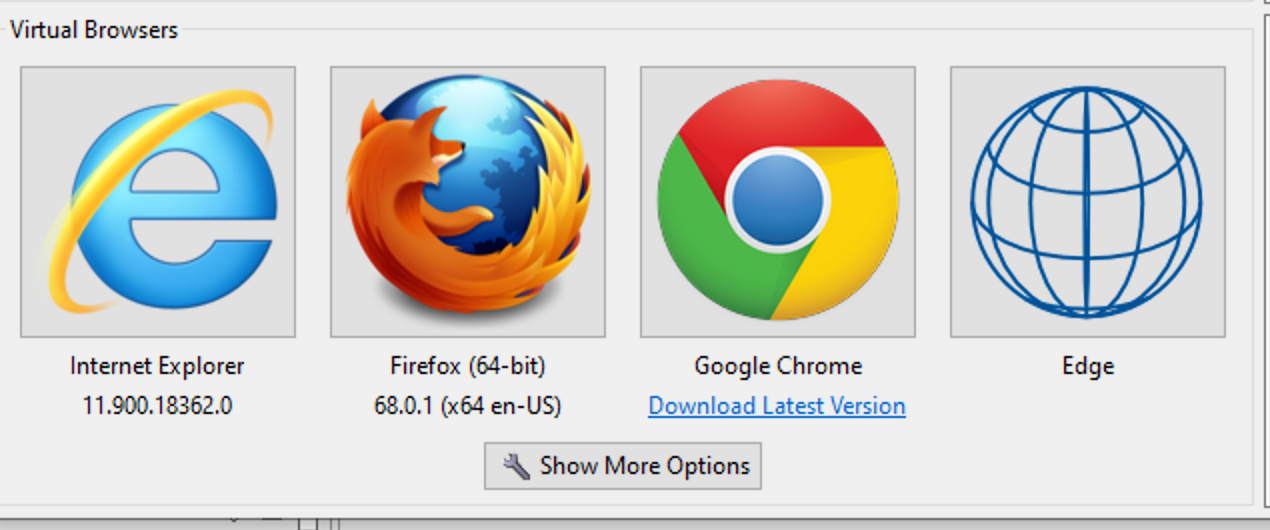
When recording you’ll now see a new option to record with Edge:
You’ll probably … Continue reading »
This Firefox extension is a plugin for SeleniumIDE that makes it easy to collect performance measurements during a test. Installing this extension will add new commands for starting and stopping timers and provides a UI for viewing and downloading the collected measurements.
ChrisWhen his dad brought home a Commodore PET computer, Chris was drawn into computers. 7 years later, after finishing his degree in Computer and Electrical Engineering at Purdue University, he found himself writing software for industrial control systems. His first foray into testing software resulted in an innovative control system for testing lubricants in automotive … Continue reading »
Over the years, I’ve see a couple of questions repeatedly on the Selenium boards related to HTTP status codes: How do I check for broken links (404s)? How can I check the status code of a web-service request made from my web-app? The answer is usually “Selenium can not do that” because, of course, Selenium is a browser automation tool – not a full-featured testing solution. Other answers suggest various solutions…none that I’ve seen are elegant.
ChrisWhen his dad brought home a Commodore PET computer, Chris was drawn into computers. 7 years later, after finishing his degree … Continue reading »
Even though interoperability has been conquered, browsers still want to compete on performance, so picking the fastest one is a reasonable question. But what does browser performance mean in a world in which many people now have 1 Gb/s network connections in their home, and a 4G LTE phone connection can go up to 173Mb/s?
We often receive questions about how Load Tester handles popup windows. In this post, I’ll describe how Load Tester handles these elements and provide a sample recording.
How does Load Tester Handle Popups?
Users do not regularly encounter popups. As a result, these windows may appear to function differently from regular browser windows.
However, when recording using a virtual browser, Load Tester records any calls to the server. Replaying a recording or running a test will replay those calls whether issued from a normal browser window or a popup.
NOTE: The following method is only applicable to “Virtual Browser” recordings.
Recording a Popup Window
1. On the … Continue reading »
The latest version of 38 Google Chrome changed the security rules so that the recording feature of Load Tester 6.1, 6.2, 6.3, and 6.4 doesn’t work right out of the box. We’re working on a fix, but in the meantime when you start recording on Chrome you’ll see this shield icon in the top right-hand corner.
Earlier last month, Microsoft began rolling out IE 11 updates for Windows 7 users. Now, with the most recent release of Load Tester 5.5, you can rest assured that Load Tester will continue to allow you to record your testcases using the upgraded IE 11.
IE 11 includes a number of new enhancements (many of which are reserved for Windows 8.1 customers). However, on Windows 7, users can still benefit from improved performance and standards support.
One of the interesting modifications of note is a new change to IE’s user agent header. Starting with IE 11, the browser … Continue reading »
Thinking about getting the latest new iPad? One of the main activities for the iPad is web browsing, so we thought it would be fun to see how all three iPad models stacked up in the web page load time race.
Which Web Pages? These websites were picked for no particular reason other than we use them regularly and are likely representative of the browsing habits of a large number of our readers.
www.amazon.com
www.apple.com
www.facebook.com
www.microsoft.com
www.wikipedia.org
www.yahoo.com
Static vs. Real-World Testing
Typically browser performance is reported by running static benchmark tests that measure in a highly controlled way with few variables. Unfortunately, when you or I … Continue reading »
In going through cases we have with some customers, we’ve seen a few instances where Internet Explorer does not cache shared static resources. Within Load Tester, this problem becomes immediately apparent:
Note that the shared CSS, Javascript, and images are re-requested again on the About page and every other recorded page that uses them. Note also, these files don’t come back with a 304 (Not Modified), but instead the full content of the file is sent over and over again through a HTTP 200. Normally, the browser should load these files once, and not need to request them again within the … Continue reading »
Load Tester 4.3 carries a number of improvements for both ease of configuration, and accuracy of test simulation. Among these improvements comes support for speculative authentication, allowing Load Tester to simulate behavior from IE 9. The speculative authentication is only used for HTTP authentication schemes used by Load Tester’s Connection Negotiation Authentication feature. More information about HTTP authentication is available under How HTTP Authentication works and why load testers should care.
To describe the speculative authentication feature, it is easiest to simply look at a testcase using Basic Authentication.
Continue reading »